How the 1500 Freestyle World Record Was Broken
Johannes Liebmann took 3.88 seconds off Bobby Finke’s 1500 freestyle world record while turning his arms over almost 8% slower. I measured every length of it.
Eric Anderson
Founder, MakoSwim · August 16, 2026 · 3 min read
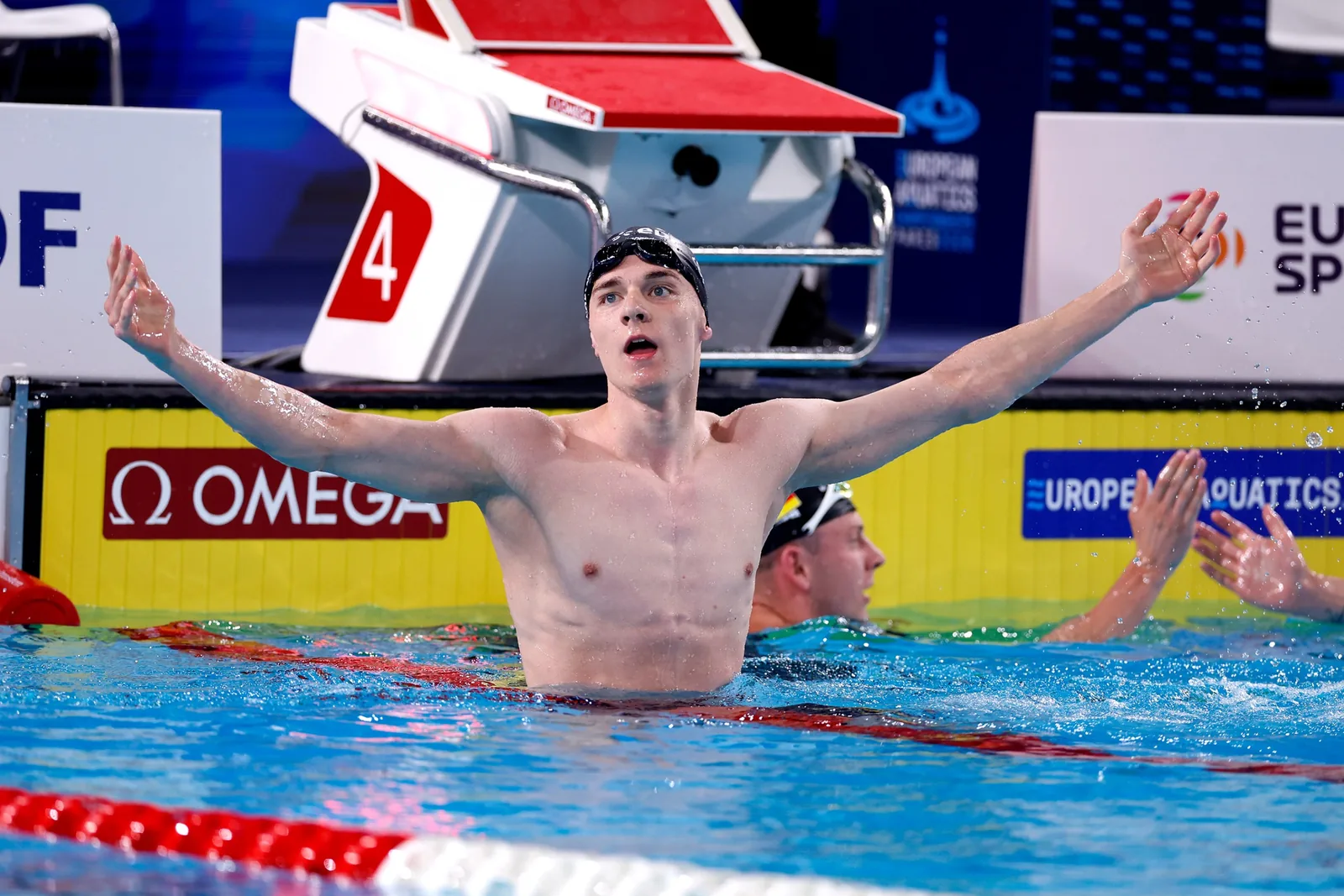
Line up the two fastest 1500s ever swum and Bobby Finke wins the last length, 26.27 to 27.39. The famous Finke finish did exactly what it was built to do, and it did not matter. Johannes Liebmann had already taken five seconds out of him, spread so thin across the other twenty-nine lengths that no single one of them looks like the place where a world record broke.
The new mark is 14:26.79, swum on 15 August at the European Championships in Paris, the first time any man has been under 14:30. Finke’s 14:30.67 had stood since the Olympic final two years earlier, in the same city. Liebmann is 19, the latest from Bernd Berkhahn’s Magdeburg group that produced Florian Wellbrock and Lukas Märtens, and he swam most of the final alone.
I tagged the race frame by frame in MakoVision the next morning, and the number that stopped me was not a split. From the 200 to the 1300, Liebmann’s stroke count read 62 on every single 100. Over the same stretch Finke’s counts crept from 65 to 68, on their way to 70 at the end. Liebmann’s did not move.
Out in 54.89, then a metronome
The swim itself was even to the point of monotony, which from a coach is a compliment. Out in 54.89, 0.58 inside record pace at the first 100. Hundreds of 57.87 to 58.35 from the 300 all the way to the 1400. He was never behind at a single 100 mark. The gap grew to 4.33 by the 800, sat in the low fours through the 1300, touched 4.72 with a hundred to go, then gave most of a second back to the Finke finish.
The full ladder is below; the Str columns are arm strokes per 100. Liebmann’s reads 62 twelve times in a row while the splits beside it barely flicker. Finke’s, after the start, climbs from 65 to 70 by the end.
| Liebmann | Finke | ||||||
|---|---|---|---|---|---|---|---|
| Dist | Cumulative | 100 | Str | Cumulative | 100 | Str | Delta |
| 100 | 54.89 | 54.89 | 59 | 55.47 | 55.47 | 61 | −0.58 |
| 200 | 1:52.43 | 57.54 | 62 | 1:53.59 | 58.12 | 65 | −1.16 |
| 300 | 2:50.49 | 58.06 | 62 | 2:51.69 | 58.10 | 66 | −1.20 |
| 400 | 3:48.38 | 57.89 | 62 | 3:50.38 | 58.69 | 67 | −2.00 |
| 500 | 4:46.25 | 57.87 | 62 | 4:49.10 | 58.72 | 68 | −2.85 |
| 600 | 5:44.51 | 58.26 | 62 | 5:47.86 | 58.76 | 68 | −3.35 |
| 700 | 6:42.52 | 58.01 | 62 | 6:46.51 | 58.65 | 68 | −3.99 |
| 800 | 7:40.85 | 58.33 | 62 | 7:45.18 | 58.67 | 68 | −4.33 |
| 900 | 8:39.09 | 58.24 | 62 | 8:43.37 | 58.19 | 68 | −4.28 |
| 1000 | 9:37.34 | 58.25 | 62 | 9:41.72 | 58.35 | 68 | −4.38 |
| 1100 | 10:35.69 | 58.35 | 62 | 10:40.01 | 58.29 | 67 | −4.32 |
| 1200 | 11:33.98 | 58.29 | 62 | 11:38.41 | 58.40 | 68 | −4.43 |
| 1300 | 12:32.33 | 58.35 | 62 | 12:36.69 | 58.28 | 68 | −4.36 |
| 1400 | 13:30.61 | 58.28 | 64 | 13:35.33 | 58.64 | 69 | −4.72 |
| 1500 | 14:26.79 | 56.18 | 68 | 14:30.67 | 55.34 | 70 | −3.88 |
The margin
Split every length into the 20 metres of pure swimming in the middle and the 30 that belong to the wall, and total each column.
| Phase | Liebmann | Finke | Delta |
|---|---|---|---|
| Opening 50, start and lap 1 | 26.42 | 26.79 | −0.37 |
| Laps 2 to 29, free-swim 20 m blocks | 334.93 | 338.55 | −3.62 |
| Laps 2 to 29, remaining 30 m per lap | 478.05 | 479.06 | −1.01 |
| Closing 50, lap 30 and finish | 27.39 | 26.27 | +1.12 |
| Total | 866.79 | 870.67 | −3.88 |
Finke wins the finish by 1.12 and loses everything else: 0.37 on the opening length, 1.01 across all the turns and breakouts together, and 3.62 in plain mid-pool freestyle, thirteen hundredths of a second at a time, in the stretch of the race nobody replays.
24 centimetres
The stroke counts already said why: a man holding the same speed on fewer strokes is taking more water with each one.
| Measure | Liebmann | Finke |
|---|---|---|
| Free-swim velocity, m/s | 1.67 | 1.65 |
| Stroke rate, cycles/min | 35.8 | 38.8 |
| Distance per stroke, m | 2.80 | 2.56 |
| Arm strokes per lap | 31.1 | 33.8 |
Velocity is stroke rate times distance per stroke, and the table settles it. Liebmann holds 1.67 metres a second on 35.8 cycles a minute; Finke needs 38.8 to hold 1.65. The difference per stroke is 24 centimetres, 2.80 against 2.56, and it shows up twice: an arm swing almost 8% slower, and more speed anyway.
If two different measuring systems make you distrust stroke rate, count arms instead. 31.1 per lap for Liebmann, 33.8 for Finke; divide 50 metres by each and the stroke comes out 8.4% longer, against 9.6% by the rate method. The two answers sit about a point apart.
The bill
Every swimmer’s stroke shortens over 1500 metres, even these two. The difference is the price each one pays to hold his speed while it happens.
| Liebmann | Finke | |||||
|---|---|---|---|---|---|---|
| Measure | Early | Late | Drift | Early | Late | Drift |
| Velocity, m/s | 1.680 | 1.667 | −0.013 | 1.653 | 1.655 | +0.002 |
| Stroke rate, cyc/min | 35.78 | 36.07 | +0.29 | 38.14 | 39.53 | +1.39 |
| Distance per stroke, m | 2.817 | 2.773 | −0.044 | 2.600 | 2.512 | −0.088 |
| Arm strokes per lap | 31.0 | 31.4 | +0.4 | 33.2 | 34.1 | +0.9 |
Neither man slows: the top row moves by about a hundredth of a metre per second for Liebmann and not at all for Finke. The cost sits below it. Finke’s stroke gives up 8.7 centimetres across the race and he pays 1.39 extra cycles a minute to cover it; Liebmann gives up 4.4 and pays 0.29. Finke is buying his back half with stroke rate; Liebmann isn’t.
Liebmann is 19, he lost the final length of his own world-record swim, and his stroke over the last ten laps had shortened about half as much as Finke’s did. The next mark in this event is probably his too.
How this was measured
Liebmann’s splits are official Omega timing. Finke’s splits, stroke rates and distance per stroke come from the French federation’s published race analysis of the Paris 2024 final. Everything else is mine, tagged in MakoVision: Liebmann’s positions through the race, and his stroke rates from timed cycles at three points in every lap.
Explore MakoSwim
Keep reading
Season Planning With the Swimmer in the Room
Most season plans aren’t short on detail. They’re short on the swimmer, and that’s the one input a spreadsheet can’t give you.
Why Swimmers Plateau, and How Data Actually Breaks It
Most plateaus aren't a fitness problem. They're a visibility problem, and that's exactly what tracked data fixes.
Your Coaching Data Shouldn't Live in Ten Places
How bringing every datapoint into one connected core helps coaches make sharper decisions, and spend more time on deck.
Coach with connected data
Workouts, video, wellness and analytics in one platform.